


How SAP Analytics Cloud Benefits Modern Businesses 2023
Even before the advent of the COVID-19 pandemic, businesses kept on facing unforeseen challenges now and then. However, this ...
Securing approval for an ERP investment is one of the most important conversations a UK business leader can have. For growing organisations, choosing the right ERP system is not just a technology decision it is a strategic investment that can influence efficiency, profitability, customer experience, and long-term growth.
However, getting approval from boards, investors, and finance teams requires more than explaining what an ERP system can do. Decision-makers need clear evidence that the investment will deliver measurable value, solve existing operational challenges, and support the future direction of the business.
Many businesses understand that disconnected systems, manual processes, and outdated reporting methods are slowing them down. Yet the challenge remains: how do you prove that investing in an ERP platform is the right move?
A strong ERP business case focuses on three key areas: the cost of current inefficiencies, the expected return on investment, and the ability of the chosen solution to deliver sustainable improvements.
SAP Business One helps UK businesses create a more connected operating environment by bringing finance, sales, inventory, purchasing, reporting, and operations together in one integrated platform. This guide explains how businesses can build a convincing ERP investment case that gains stakeholder confidence and supports smarter decision-making.
The strongest ERP business cases do not begin by discussing software features. They begin by identifying the problems that already exist within the organisation.
Many businesses underestimate the hidden costs created by disconnected systems. When teams rely on spreadsheets, separate applications, and manual processes, valuable time is lost every day. Employees may spend hours searching for information, correcting data errors, reconciling reports, or manually transferring information between departments.
These inefficiencies create a direct financial impact. For example, a finance team working with multiple systems may spend excessive time preparing reports instead of analysing business performance. Sales teams may struggle to access accurate inventory information, resulting in delayed customer responses or missed opportunities. Operations teams may discover problems only after they have already affected customers.
Before presenting an ERP proposal, businesses should calculate what these challenges are costing them. This includes employee time spent on repetitive tasks, financial losses caused by mistakes, delayed decisions, inefficient inventory management, and missed growth opportunities.
By measuring the current situation, stakeholders can clearly see that ERP investment is not simply an additional cost. It is a solution designed to eliminate existing operational losses and create measurable improvements.
Once the current costs are understood, the next step is to demonstrate the value an ERP system will bring to the organisation.
A successful ERP business case should connect expected improvements with real business outcomes. Instead of making general statements about efficiency, businesses should explain how the system will improve specific processes and contribute to financial performance.
For UK businesses, SAP Business One can deliver value through improved automation, better visibility, and stronger operational control. With industry-focused ERP solutions designed to support different business requirements, organisations can streamline processes, improve decision-making, and increase efficiency across operations, including ERP software for automotive industry.
Some of the most common ERP benefits include:
Reduced manual administration and repetitive tasks
Faster access to accurate business information
Improved inventory planning and stock control
Better customer service through connected data
More effective financial management
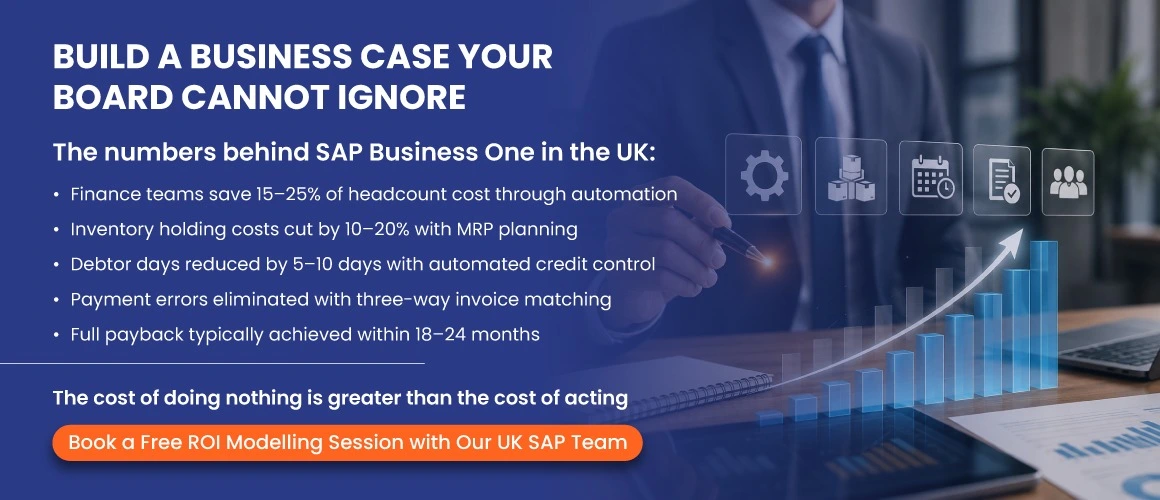
The most convincing proposals are built around measurable results. For example, rather than saying an ERP system will “improve productivity,” businesses should explain how many hours can be saved, how reporting time can be reduced, or how operational costs can be lowered.
When benefits are supported with realistic calculations, stakeholders can better understand the potential return on investment.
One of the biggest mistakes businesses make when presenting an ERP proposal is focusing only on the initial software cost. Experienced decision-makers understand that ERP investment involves more than purchasing licences.
A realistic ERP business case should include the complete cost of ownership. This includes implementation, configuration, employee training, data migration, support, maintenance, and infrastructure requirements.
A complete cost analysis helps stakeholders understand the full financial picture and avoids unexpected expenses later in the project.
For many UK businesses, cloud-based ERP solutions such as SAP Business One provide additional flexibility by reducing the need for large infrastructure investments. Cloud deployment allows businesses to manage costs more predictably while benefiting from secure and scalable technology.
A five-year comparison between expected costs and expected benefits is often one of the most effective ways to present an ERP proposal. It allows boards and finance teams to see not only the initial investment but also the long-term value created by the system.
A strong business case should demonstrate that ERP is not simply a technology purchase it is an investment in operational improvement and future growth.
One of the main reasons ERP projects face delays in approval is concern about implementation risk. Business leaders have often heard stories about technology projects that exceeded budgets, disrupted operations, or failed to deliver expected results.
These concerns are understandable. An ERP system affects multiple areas of a business, so careful planning is essential.
The best way to reduce implementation risk is to show that the project has been properly planned. This includes selecting an experienced ERP partner, defining clear project goals, preparing employees for change, and creating a realistic implementation timeline.
A reliable SAP Business One implementation partner can help businesses manage:
System configuration and business requirements
Data migration and accuracy checks
Employee training and adoption
Project planning and ongoing support
Change management is also an important part of ERP success. Employees need to understand why the system is being introduced and how it will improve their daily work. Proper training and communication help ensure that the organisation gains maximum value from the new platform.
Business leaders want to know when they will begin seeing results from an ERP investment. A strong proposal should include a realistic timeline showing how benefits will develop after implementation.
ERP value is usually delivered gradually. Some improvements appear immediately, while others become more visible as teams adopt new processes and use better data.
In the early stages, businesses often experience benefits such as faster reporting, reduced manual tasks, and improved workflow management. As the system becomes embedded into daily operations, organisations typically see stronger inventory control, better customer management, improved forecasting, and more efficient decision-making.
Over time, the combined impact of these improvements contributes to higher productivity and stronger business performance.
A successful ERP business case does not only explain the benefits it also prepares for potential objections.
Finance teams may question the cost. Managers may worry about disruption. Employees may be concerned about learning a new system. These concerns should be addressed before they become barriers to approval.
The best approach is to provide clear, evidence-based answers. Show how the ERP system will improve existing challenges, explain how implementation disruption will be managed, and demonstrate how employees will be supported throughout the transition.
Justifying an ERP investment requires more than presenting a list of software features. UK businesses need to demonstrate how the investment will solve current problems, improve efficiency, reduce costs, and support future growth.
A strong ERP business case begins with understanding the true cost of existing processes, building a realistic ROI model, presenting complete ownership costs, and addressing implementation risks with a clear strategy.
SAP Business One provides UK businesses with the tools needed to connect operations, improve visibility, automate processes, and make better decisions. By presenting the investment in terms of measurable business value, organisations can create a stronger case that gains approval from boards, investors, and finance teams.
The process of building an ERP business case also helps businesses understand their own operations more clearly. It highlights inefficiencies, identifies opportunities, and creates a roadmap for future improvement.
Need help building your ERP business case? Our UK SAP Business One consultants offer free ROI modelling sessions for businesses evaluating their options. Contact us today to get started.

An experienced business leader, heads the UK operations of Silver Touch Technologies Ltd. With 15 years of experience in the industry, he has set the track record of delivering transformation and revenue growth with SAP Solutions.