

Boost Asset Visibility and Operational Efficiency with SAP Business One
For UK businesses managing significant portfolios of physical assets whether manufacturing equipment, vehicle fleets, IT in...
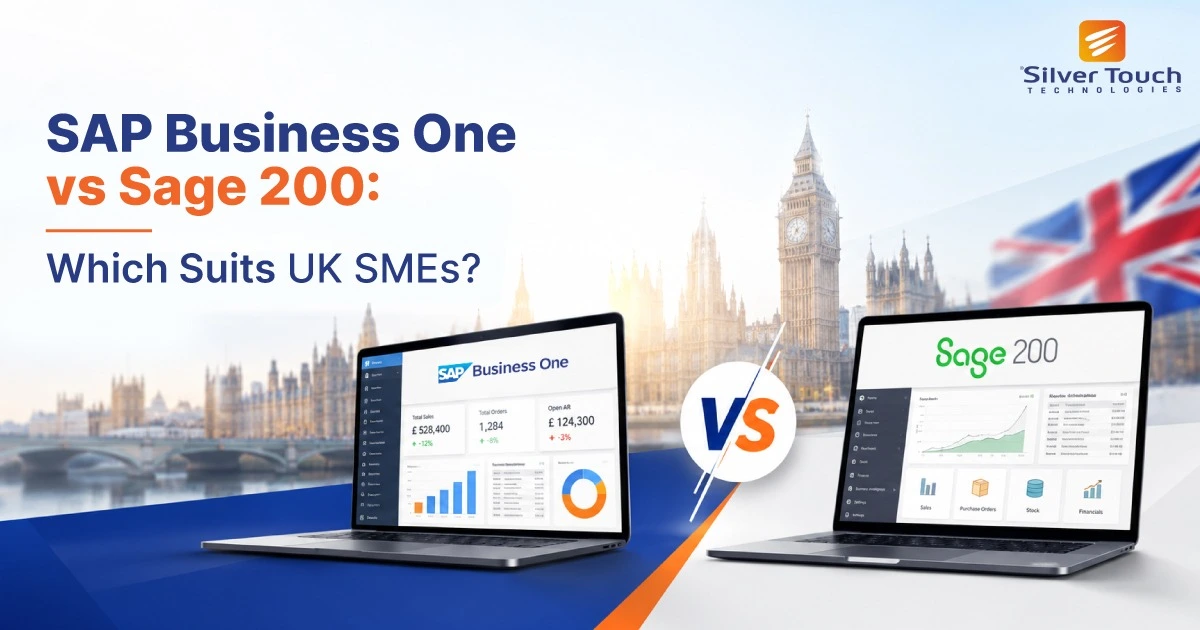
If your business has outgrown Sage 50, Xero or a patchwork of spreadsheets, two names tend to top the shortlist: SAP Business One and Sage 200. Both are proven ERP systems with thousands of UK customers, and both handle Making Tax Digital. Yet they are built on different philosophies, and choosing the wrong one can cost you years of workarounds. The SAP Business One vs Sage 200 decision is really a question about where your business is heading.
In this guide, we compare the two side by side for UK SMEs. We cover core functionality, inventory and manufacturing, reporting, deployment options, compliance and total cost of ownership. By the end, you should have a clear view of which system fits your business today and in five years’ time.
SAP Business One (often shortened to SAP B1) is SAP’s ERP for small and mid-sized businesses. It brings finance, sales, purchasing, inventory, production, CRM and reporting into one database. It runs on Microsoft SQL Server or SAP HANA, the in-memory database that powers SAP’s enterprise products. Businesses can deploy it on-premise, in a private cloud or as a partner-hosted subscription.
Its sweet spot is the growing SME with operational complexity: manufacturers, wholesalers and distributors, and companies trading internationally or running several entities.
Sage 200 is the mid-market step up from Sage 50 and comes in two editions. Sage 200 Standard is the cloud edition, while Sage 200 Professional is the more customisable, modular version for on-premise or hybrid use. It covers financials and commercials (sales order processing, purchase order processing and stock), with CRM, manufacturing and project accounting available as extra modules or third-party add-ons.
Sage 200’s biggest advantage in the UK is familiarity. Many finance teams already know Sage, and moving up from Sage 50 feels like a natural next step.
| Criteria | SAP Business One | Sage 200 |
|---|---|---|
| Best suited to | Growing SMEs with complex operations, typically 10–250 users | Finance-led SMEs, often moving up from Sage 50 |
| Core strength | Single integrated ERP covering finance, operations and CRM | Strong UK accounting and familiar Sage interface |
| Inventory and warehousing | Native multi-warehouse, bin locations, batch and serial tracking | Good stock control; advanced warehousing usually via add-ons |
| Manufacturing | Bills of materials, production orders and MRP built in | Typically via third-party manufacturing add-ons |
| Multi-company and multi-currency | Strong, with intercompany options for international groups | Professional supports many companies; best for UK-centric groups |
| Reporting and analytics | Real-time dashboards and analytics, especially on SAP HANA | Standard reports, Excel reporting and Power BI options |
| Deployment | On-premise, private cloud or partner-hosted subscription | Standard: Sage cloud. Professional: on-premise or hybrid |
| Making Tax Digital | Supported through UK localisation | Supported natively |
| Scalability path | Moves to SAP S/4HANA if you outgrow it | Moves to Sage Intacct or Sage X3 |
Sage 200 began life as accounting software, and its finance modules remain excellent. Nominal, sales and purchase ledgers, cash book and VAT are mature and familiar to UK bookkeepers.
SAP Business One was designed as an end-to-end ERP from day one. Every sales order, goods receipt and production run posts to the ledger automatically. If your pain points sit outside the finance office, in the warehouse, on the shop floor or in customer service, SAP B1 usually covers more ground out of the box.
This is where the gap is widest. SAP Business One includes multi-warehouse management, bin locations, batch and serial number tracking, bills of materials and material requirements planning (MRP) as standard.
Sage 200 handles stock control well for traders and wholesalers. For production planning, advanced warehousing or full traceability, most businesses add third-party modules. Add-ons work, but each one adds cost, another supplier and another upgrade to coordinate.
Sage 200 offers solid standard reports, Excel-based reporting and Power BI connections, and its finance reporting is familiar to accountants.
SAP Business One on HANA gives users live dashboards, drill-down analytics and fast queries across large data sets. For directors who want one version of the truth across sales, stock and margin, that is a meaningful advantage.
Sage 200 Standard is a Sage-hosted cloud product with less scope for customisation. Sage 200 Professional offers deeper tailoring but is mostly deployed on-premise or in hybrid set-ups.
SAP Business One gives you the same product whichever way you deploy it. You can run it on your own server, in a private cloud, or as a subscription hosted by your partner, with a browser-based Web Client for remote and hybrid teams.
Both systems support Making Tax Digital for VAT, UK VAT rates, reverse charge and UK GAAP (FRS 102) reporting. Sage’s home-grown heritage gives it an edge in UK-specific familiarity. However, SAP B1’s UK localisation covers VAT codes, reverse-charge handling and the UK chart of accounts, so compliance alone rarely decides the choice.
If you plan to open overseas entities, acquire businesses or double your headcount, SAP Business One scales comfortably. It supports multi-currency, many languages and localisations across dozens of countries, and gives you a clear upgrade path within the SAP family. Sage 200 suits UK-centric groups well, but international expansion often triggers a move to a different Sage product.
On headline licence price, Sage 200 usually looks cheaper. Independent UK estimates put Sage 200 Standard at roughly £393 a month including three users, with Professional starting nearer £374 a month for one user. SAP Business One subscriptions are typically quoted per user, with indicative cloud pricing of about £70–£95 per professional user per month, or a perpetual licence of around £2,500–£3,500 per user. Treat all these figures as indicative; your partner will quote on your exact users and modules.
Licence fees are only part of the picture. When you compare total cost of ownership over five years, include:
A business that needs Sage 200 plus three or four add-ons can end up paying as much as, or more than, a single SAP Business One system that covers those needs natively.
A useful test: list the five processes that cause the most friction today. If most sit inside the finance team, Sage 200 is a strong contender. If they span the warehouse, production and customer service, SAP Business One is likely the better long-term fit.
The SAP Business One vs Sage 200 decision comes down to scope and ambition. Sage 200 is a dependable, familiar choice for UK businesses whose priority is better financial management. SAP Business One is built for SMEs that need one integrated system across finance, stock, production and sales, and room to grow without changing platforms again.
Whichever way you lean, judge each system on your real processes rather than a generic demo. Ask for a scripted demonstration using your own data and workflows.
Our certified SAP Business One consultants work with UK SMEs every day. We’ll review your current set-up, map your key processes and show you exactly how SAP Business One would work for you, with no obligation.

An experienced business leader, heads the UK operations of Silver Touch Technologies Ltd. With 15 years of experience in the industry, he has set the track record of delivering transformation and revenue growth with SAP Solutions.