
MRP Software: The Pathway to Boost Your Manufacturing Efficiency in 2025
In the current competition, efficiency, accuracy and great flexibility is the most important requirement for a manufacturer...
If you’re running a growing business in the UK and still relying on spreadsheets or disconnected systems to track your sales performance, you’re likely missing out on insights that could genuinely move the needle.
SAP Business One is one of the most powerful ERP solutions available to small and mid-sized businesses and its sales performance tools are often what wins people over. Whether you’re a sales manager in Manchester, a finance director in London, or a business owner in Birmingham, SAP B1 gives you a single, clear view of how your team is performing and more importantly, where the opportunities lie.
In this guide, we’ll walk you through exactly how to evaluate sales performance using SAP Business One, the key metrics to track, and why UK businesses are increasingly turning to it as their go-to ERP platform.
Did you know? UK SMEs that use integrated ERP systems like SAP Business One report up to 30% faster decision-making thanks to real-time sales dashboards.
The UK market is competitive. Whether you’re in retail, manufacturing, professional services, or distribution, understanding your sales data isn’t just nice to have it’s essential for survival and growth.
Most businesses track revenue. But the truly successful ones go deeper. They track:
Which products or services are driving profit not just revenue
Which sales reps are consistently hitting targets (and which need support)
How long deals take to close and where they stall
Customer lifetime value and repeat purchase rates
Seasonal patterns and demand forecasting
SAP Business One brings all of this together in one place, removing the need for multiple tools or manual data consolidation.
One of the biggest advantages of SAP B1 is the depth of reporting available out of the box. Here are the core metrics UK sales teams are tracking:
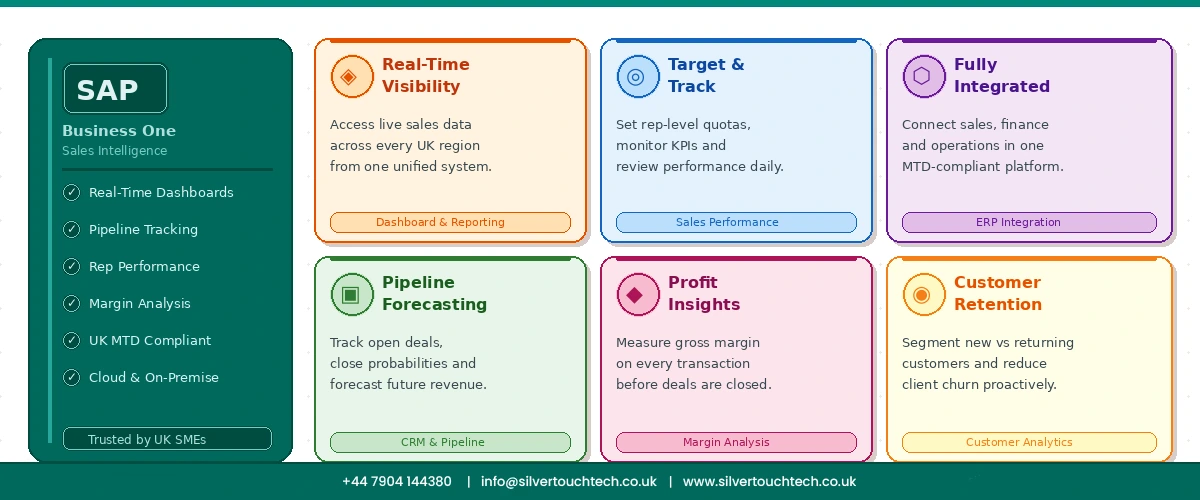
Track monthly, quarterly, and annual sales performance against targets with real-time reporting in SAP Business One. Businesses can compare current revenue with previous periods instantly without relying on manual spreadsheets. The system also allows drill-down reporting by product line, sales channel, or sales representative for better decision-making.
Understand which customers, regions, or territories generate the most revenue. SAP B1 provides detailed insights by customer group, postcode region, or sales territory, helping UK businesses identify top-performing markets and focus sales efforts where growth opportunities are strongest.
SAP B1 calculates gross profit margins automatically for every transaction, giving businesses full visibility into deal profitability. Sales teams can monitor the impact of discounts in real time, while finance teams gain accurate margin reporting based on current supplier and landed costs.
Measure individual and team performance using built-in dashboards. Track quotas, conversion rates, average deal value, and sales activity in real time. This helps managers identify performance trends early and simplifies commission and incentive calculations.
With integrated CRM functionality, SAP Business One tracks opportunities from quotation to closed deal. Businesses can monitor deal stages, expected close dates, and forecasted revenue, helping leadership teams make more confident and data-driven decisions.
SAP B1 helps businesses analyse revenue from new versus existing customers. This visibility allows companies to identify customer retention risks, improve repeat sales strategies, and invest marketing budgets more effectively for long-term growth.
SAP Business One offers several tools for generating and analysing sales performance data:
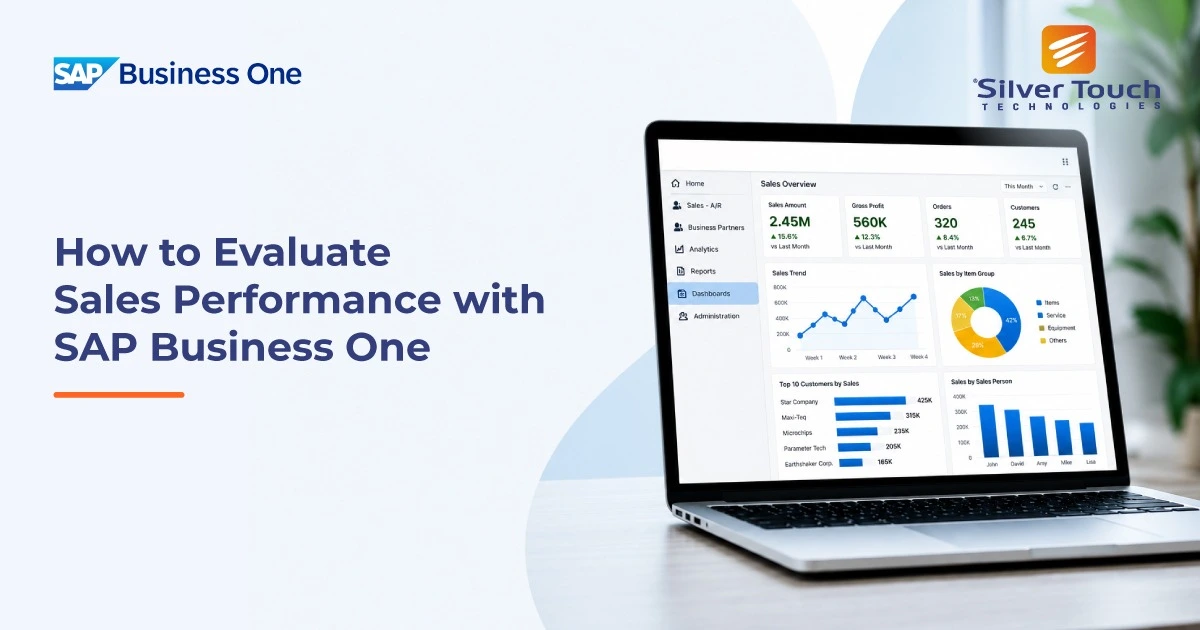
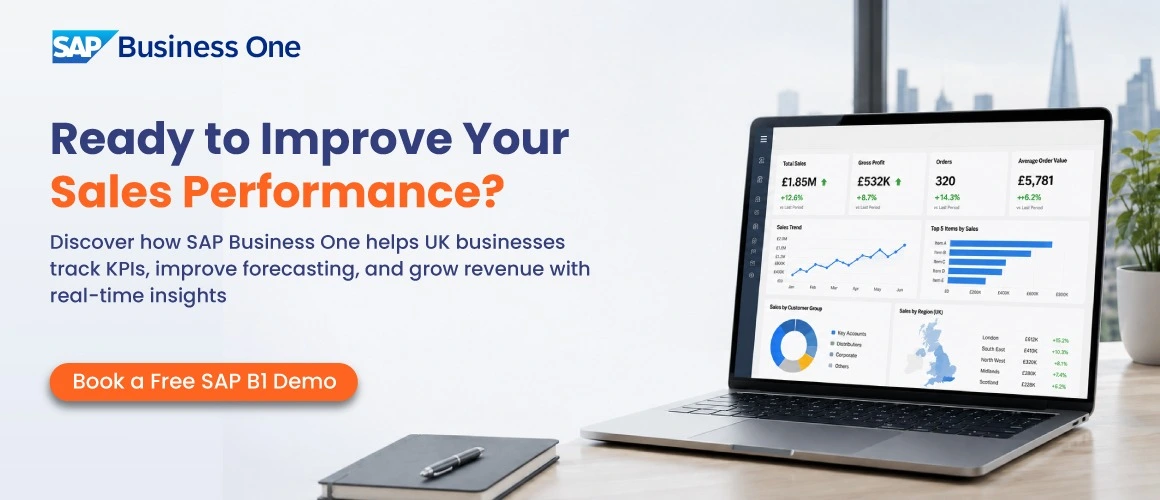
The SAP B1 cockpit gives users a visual, real-time overview of key metrics. Sales managers can see pipeline values, open orders, and revenue trends at a glance without having to run a single report manually.
For more detailed, formatted reports, SAP B1 integrates with SAP Crystal Reports. This allows businesses to create bespoke reports tailored to their specific needs ideal for board presentations or board-level reporting.
More technical users can use the built-in Query Generator to pull custom data sets, while XL Reporter allows direct integration with Microsoft Excel for familiar, flexible reporting.
With SAP Business One’s mobile app, sales reps and managers across the UK can access live dashboards and reports on the go whether they’re visiting clients in Edinburgh or working remotely in Bristol.
Real Talk: One of the most common things we hear from UK businesses switching to SAP Business One is that they finally feel in control of their numbers. When everything is in one place, you stop firefighting and start planning.
Getting the most from SAP B1’s reporting tools starts with defining the right KPIs for your business. Here’s a practical approach:
Work with your sales leadership team to identify the top 5-8 metrics that directly reflect business performance. Focus on metrics you can act on, not just observe.
SAP Business One has dozens of built-in reports. Work with your implementation partner to map each KPI to the right report or dashboard widget.
Without targets, data is just numbers. Set monthly and quarterly benchmarks based on historical performance and your growth goals. SAP B1 allows you to enter targets per rep, region, or product line.
Build a cadence of weekly or bi-weekly sales reviews using SAP B1 dashboards. This creates accountability and ensures issues are caught early.
There are plenty of ERP options on the market, but SAP Business One consistently stands out for UK SMEs for several reasons:
It’s built for growing businesses not just enterprise giants
HMRC-compliant with built-in VAT reporting and Making Tax Digital (MTD) support
Scalable from 5 to 250+ users without a full system overhaul
Strong local UK implementation partner network for support and customisation
Trusted SAP brand with 30+ years of ERP expertise
Cloud and on-premise deployment options to suit your infrastructure
Whether you’re looking to replace a legacy system or take your business beyond QuickBooks or Sage, SAP Business One offers a significant step up in capability especially when it comes to sales performance management.
Ready to take control of your sales performance? Speak to a UK-based SAP Business One partner today and discover how SAP B1 can transform the way you measure and grow your business.

An experienced business leader, heads the UK operations of Silver Touch Technologies Ltd. With 15 years of experience in the industry, he has set the track record of delivering transformation and revenue growth with SAP Solutions.