
3 Reasons Why Your Inventory Cost You Money in Wholesale Distribution
Inventory analysis plays a vital role in the wholesale distribution business. It involves the analysis of various aspects lik...
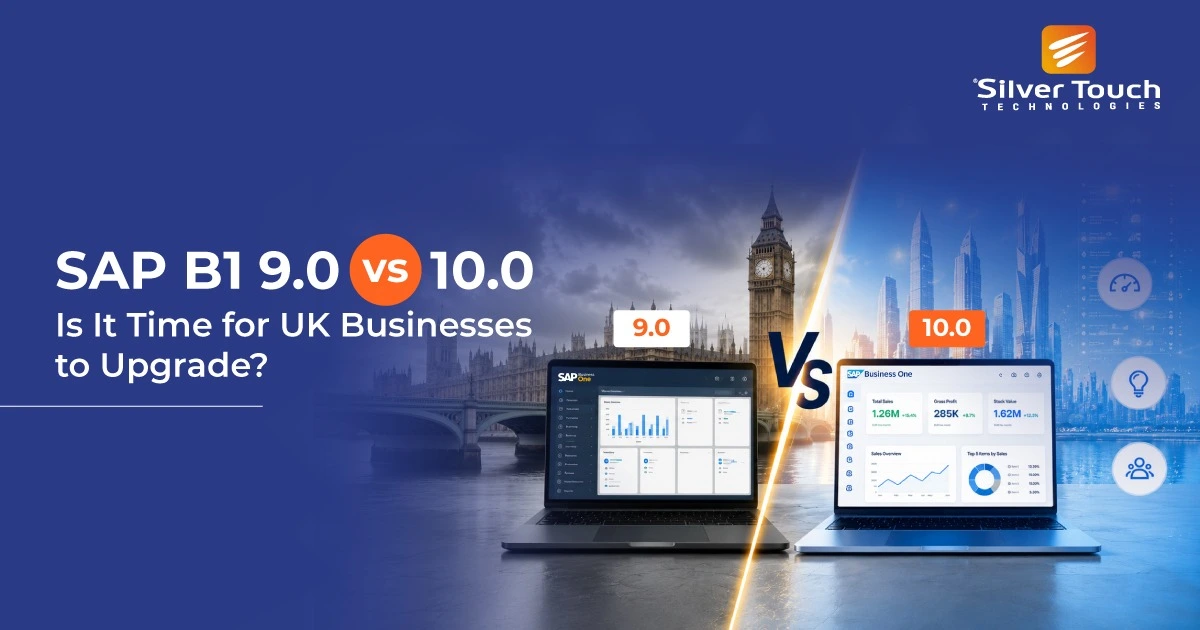
Perhaps the most visible difference between the two versions is how users interact with the software. SAP Business One 9.0 relied entirely on a Windows desktop client a traditional, form-based interface that required installation on every machine and could only be accessed remotely via VPN or Citrix. For businesses with mobile or hybrid teams, this created real operational friction.
Version 10.0 changes this completely with the SAP Business One Web Client, built on SAP Fiori design principles and accessible from any browser without installation. By 2025, the Web Client covers all core modules and has become the default interface for many businesses. Key improvements include:
Fully responsive layout across desktops, tablets, and smartphones
Role-based home screens with personalised tiles and live dashboards
Drag-and-drop sales pipeline and streamlined purchasing workflows
Interactive Chart of Accounts with hierarchical financial navigation
For UK businesses with remote or multi-site teams, this shift to a browser-based interface means staff can access live ERP data securely from anywhere — without a VPN or SAP Business One Mobility Solution.
This is arguably the most critical difference for UK businesses. SAP Business One 9.0 predates several of the most significant regulatory changes to affect UK companies in recent history HMRC’s Making Tax Digital for VAT (April 2019), GDPR (May 2018), and the post-Brexit trade documentation changes (January 2021). Running version 9.0 today therefore means managing compliance through manual workarounds, third-party add-ons, or custom development.
Version 10.0 was built and continuously updated with these requirements in mind. The compliance improvements it delivers include:
Full Making Tax Digital (MTD) compliance with direct VAT submission to HMRC
MTD for Corporation Tax readiness ahead of the upcoming rollout
Built-in GDPR data management tools including consent tracking and data deletion workflows
Post-Brexit import and export documentation, including UK-EU customs support
Automatic compliance patches delivered via SAP’s regular support package cycle
For UK businesses still on version 9.0, the compliance gap is a compelling reason to upgrade. The ongoing cost of maintaining workarounds often exceeds the cost of migration.
In SAP Business One 9.0, reporting was built primarily around Crystal Reports and the Query Manager. Both are capable tools, but they require technical knowledge to configure and are rarely accessible to front-line managers without IT support. Most businesses fell into a familiar pattern exporting data to Excel, building pivot tables, and circulating static spreadsheets that were out of date almost as soon as they were sent.
Version 10.0 replaces this workflow with embedded real-time analytics. Finance directors and operations managers can access live dashboards, visual KPIs, and interactive reports directly within the Web Client, without exporting a single file. The Pervasive Analytics feature displays contextual data alongside the records it relates to, giving users insight at the point of decision rather than after the fact. Native Microsoft 365 integration further allows teams to pull live SAP data into Excel or Teams for collaborative forecasting and planning.
SAP Business One 9.0 had no native AI or machine learning capabilities. Any intelligent automation required expensive custom development or third-party software putting it out of reach for most UK SMEs. Version 10.0 changes this by integrating SAP Business One AI capabilities directly into everyday business processes in a practical, accessible way. The key automation capabilities include:
Automated invoice scanning — AI reads and processes supplier invoices, significantly reducing manual data entry in accounts payable
Intelligent cash flow forecasting — analyses historical patterns to project future cash positions
Anomaly detection in financial data — flags unusual transactions before they reach month-end
Document matching and reconciliation automation — accelerates period-close processes
These features are built into the standard platform and designed for businesses with teams of ten to two hundred people. For UK SMEs facing ongoing pressure on margins and headcount, the efficiency gains from these tools represent a clear and measurable return on the cost of upgrading.
Version 9.0 was primarily an on-premise system. Cloud-hosted options existed through SAP partners, but they were essentially on-premise installations running on remote servers not true cloud architectures. Updates, backups, and security patching all required IT resource and planned downtime.
Version 10.0 is designed cloud-first. Businesses can choose from three deployment models:
On-premise on SQL or HANA — for businesses that prefer to manage their own infrastructure
Cloud-hosted via SAP or UK partner hosting — with UK data centre options for data residency requirements
Hybrid deployment — combining on-premise core systems with cloud-hosted functionality
Cloud deployments receive updates automatically, removing the maintenance burden from internal IT teams entirely. Licencing also scales with headcount, making version 10.0 more cost-effective for growing businesses than the fixed-cost model associated with older on-premise installations.
Integration in version 9.0 was primarily achieved through the Data Transfer Workbench or custom development via the SAP SDK approaches that were functional but costly and slow to maintain. Connecting SAP Business One to modern SaaS platforms or e-commerce systems typically required specialist SAP development resource.
Version 10.0 introduces the SAP Business One Service Layer, a modern REST API that simplifies integration considerably. Combined with SAP’s Business Technology Platform, UK businesses can now connect to a much broader ecosystem without specialist development. The most commonly used integrations include:
Microsoft 365, Teams, and SharePoint — for collaborative working and reporting
Shopify, WooCommerce, and Amazon — for e-commerce order and inventory management
UK banking platforms — for automated payment processing and reconciliation
HMRC APIs — for direct tax submission and compliance reporting
| Feature | SAP Business One 9.0 | SAP Business One 10.0 |
|---|---|---|
| User Interface | Windows desktop client only | Browser-based Web Client + Desktop Client |
| Remote Access | VPN or Citrix required | Any browser, any device, no VPN needed |
| MTD Compliance | Not supported natively | Full MTD VAT; MTD Corporation Tax ready |
| GDPR Tools | Not included | Built-in consent and data management tools |
| Post-Brexit Support | Not applicable | UK-EU customs and import/export documents |
| Reporting | Crystal Reports and Excel exports | Real-time dashboards, embedded KPIs |
| AI & Automation | No native capabilities | Invoice scanning, cash flow AI, anomaly detection |
| Cloud Deployment | On-premise primary | Cloud-first; UK data centre options available |
| Integration | SDK and DTW; custom development required | REST API Service Layer; Microsoft 365 native |
| Updates | Manual patching required | Automatic via support package cycle |
Any UK business still running SAP Business One 9.0 or earlier should be planning an upgrade. Version 9.0 is no longer receiving new feature development, and the gap between what it can do and what version 10.0 delivers grows wider with every SAP feature pack release.
The case is particularly strong for finance teams managing MTD submissions through workarounds, for businesses with remote or hybrid workforces who need browser-based ERP access, and for businesses looking to reduce IT maintenance overhead by moving to the cloud. For those still relying on Excel-based reporting, the real-time analytics improvements in version 10.0 alone can justify the investment.
Upgrading from SAP Business One 9.0 to 10.0 is a structured project typically completed within 4 to 12 weeks, depending on the complexity of your existing configuration and any custom add-ons in place. The process covers system and database assessment, data migration planning, sandbox testing, user training on the Web Client, and a managed go-live with hypercare support.
Working with an authorised UK SAP Business One partner ensures UK-specific configuration including MTD, payroll, and HMRC compliance is handled correctly from the outset, reducing risk and keeping the project on schedule.
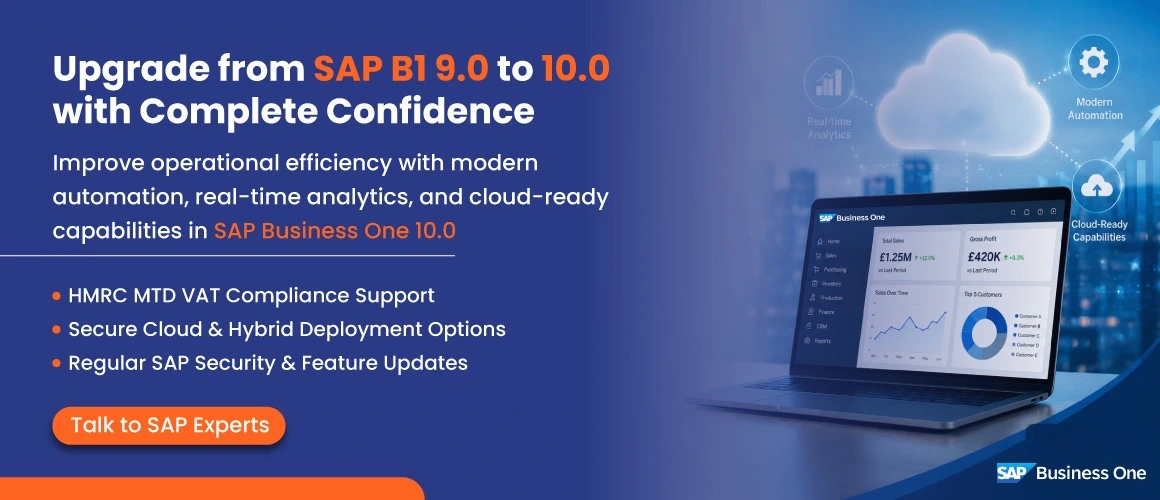
Silver Touch Technologies UK is an experienced SAP Business One partner working with UK businesses across manufacturing, distribution, professional services, and retail. Whether you are upgrading from version 9.0, moving from a different ERP system, or implementing SAP Business One for the first time, our UK-based team manages the full process from assessment to go-live.
Contact us today for a free SAP Business One demonstration tailored to your industry and business size.
SAP Business One 9.0 is no longer receiving mainstream feature development or modern compliance enhancements. Businesses using older versions may face limitations in security, reporting, integrations, and compliance support.
UK businesses are upgrading to SAP Business One 10.0 for browser-based access, MTD compliance support, real-time analytics, cloud flexibility, and improved automation.
Yes. SAP Business One 10.0 supports HMRC Making Tax Digital requirements through compatible UK localisation and compliance integrations for VAT submissions.
Yes. SAP Business One 10.0 supports on-premise, cloud-hosted, and hybrid deployment models based on business requirements.
Most SAP Business One upgrade projects are completed within 4 to 12 weeks, depending on database complexity, integrations, and existing customisations.

An experienced business leader, heads the UK operations of Silver Touch Technologies Ltd. With 15 years of experience in the industry, he has set the track record of delivering transformation and revenue growth with SAP Solutions.